Crème Brûlée Recipe
User Reviews
4.7
Crème Brûlée Recipe
Description
The Crème Brûlée recipe begins by infusing heavy cream with sugar, salt, and vanilla bean seeds and pod by bringing it to a boil and steeping off heat to extract flavor. Egg yolks are whisked separately and tempered with warm cream in batches to avoid curdling before the full mixture is strained into ramekins. These are set in a towel-lined baking dish and baked in a hot water bath to ensure gentle, even cooking for a silky custard.
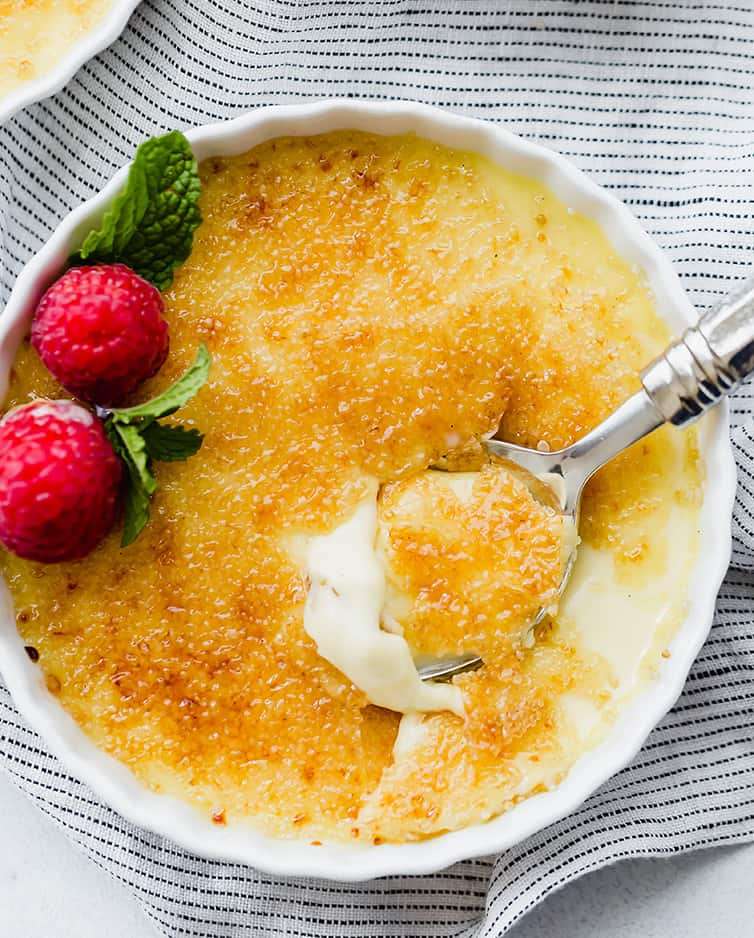
Once cooled thoroughly, sugar is sprinkled evenly atop each custard and caramelized using a kitchen torch or broiler which creates a glossy, crisp crust. The contrast of this sugar crust with the smooth and rich vanilla custard beneath is characteristic of the dessert. Quality vanilla bean produces a pronounced, natural flavor, but vanilla extract is an acceptable alternative.
This dessert is plated chilled and finished right before serving so the caramelized crust remains crisp. It can be made several days in advance, stored refrigerated, and only torched just prior to eating. If desired, the custard can also be frozen after baking and thawed before topping and caramelizing.
The recipe notes alternatives for equipment and ingredients, including substitutes for vanilla bean, torch, and ramekins, as well as useful tips on egg handling and proper storage to maintain custard texture and surface integrity.
Ingredients
- 4 cups heavy cream chilled
- ⅔ cup granulated sugar
- Pinch salt
- 1 vanilla bean halved lengthwise
- 12 egg yolk
- 8-12 teaspoons turbinado sugar or Demerara sugar
Special Equipment
- Kitchen torch
- ramekins
- instant-read thermometer
Instructions
- Adjust oven rack to lower-middle position and heat oven to 300 degrees F.
- Combine 2 cups of the cream, the sugar, and salt in medium saucepan; with a paring knife, scrape seeds from vanilla bean into pan, submerge pod in cream, and bring mixture to a boil over medium heat, stirring occasionally to ensure that sugar dissolves. Take pan off heat and let steep 15 minutes to infuse flavors.
- Meanwhile, place kitchen towel in bottom of large baking dish or roasting pan and arrange eight 4- to 5-ounce ramekins (or shallow fluted dishes) on towel. Bring kettle or large saucepan of water to boil over high heat.
- After cream has steeped, stir in remaining 2 cups cream to cool down mixture. Whisk yolks in large bowl until broken up and combined. Whisk about 1 cup cream mixture into yolks until loosened and combined; repeat with another 1 cup cream. Add remaining cream and whisk until evenly colored and thoroughly combined. Strain through fine-mesh strainer into 2-quart measuring cup or pitcher (or clean medium bowl); discard solids in strainer. Pour or ladle mixture into ramekins, dividing it evenly among them.
- Carefully place baking dish with ramekins on oven rack; pour boiling water into dish, taking care not to splash water into ramekins, until water reaches two-thirds height of ramekins. Bake until centers of custards are just barely set and are no longer sloshy and digital instant-read thermometer inserted in centers registers 170 to 175 degrees, 30 to 35 minutes (25 to 30 minutes for shallow fluted dishes). Begin checking temperature about 5 minutes before recommended time.
- Transfer ramekins to wire rack; cool to room temperature, about 2 hours. Set ramekins on rimmed baking sheet, cover tightly with plastic wrap, and refrigerate until cold, at least 4 hours or up to 4 days.
- Uncover ramekins; if condensation has collected on custards, place paper towel on surface to soak up moisture. Sprinkle each with about 1 teaspoon turbinado sugar (1½ teaspoons for shallow fluted dishes); tilt and tap ramekin for even coverage. Ignite kitchen torch and caramelize sugar. Refrigerate ramekins, uncovered, to re-chill, 30 to 45 minutes (but no longer); serve.
Notes
- Vanilla bean can be substituted with 2 teaspoons vanilla extract or vanilla bean paste, added when whisking egg yolks.
- Whisk yolks after the cream has steeped to avoid forming a dry film on their surface.
- Use turbinado or Demerara sugar for topping; granulated sugar can be used sparingly (1 scant teaspoon per ramekin).
- If a kitchen torch is unavailable, the oven broiler can caramelize the sugar when custards are fully chilled.
- Ramekins are ideal, but a wide ceramic pan can be used with adjusted baking time and proper water bath setup.
- The dessert can be made up to 4 days ahead by preparing and chilling the custard; caramelize sugar just before serving.
- Prepared custards can be frozen for up to 1 month; thaw in refrigerator before torching.
- Store leftovers refrigerated for up to 2 days; best eaten immediately after caramelizing.
Nutrition Information
Show DetailsNutrition Facts
Serving: 8servings
Amount Per Serving
Calories 579 kcal
% Daily Value*
| Calories | 579kcal | 29% |
| Carbohydrates | 25g | 8% |
| Protein | 6g | 12% |
| Fat | 51g | 78% |
| Saturated Fat | 29g | 145% |
| Cholesterol | 455mg | 152% |
| Sodium | 62mg | 3% |
| Potassium | 118mg | 3% |
| Sugar | 20g | 40% |
| Vitamin A | 2140IU | 43% |
| Vitamin C | 0.7mg | 1% |
| Calcium | 112mg | 11% |
| Iron | 0.8mg | 4% |
* Percent Daily Values are based on a 2,000 calorie diet.
User Reviews
Overall Rating
4.7
You'll Also Love