Fruit Custard Recipe (Homemade & Easy)
User Reviews
4.8
Fruit Custard Recipe (Homemade & Easy)
Description
The custard sauce is prepared by warming milk on low heat and dissolving sugar. Separately, custard powder is mixed into a small amount of warm milk to make a lump-free slurry. This slurry is gradually whisked into the warm milk, stirring constantly to prevent lumps and browning. The mixture is cooked further until slightly thickened but not overly thick, allowing it to thicken more upon cooling.
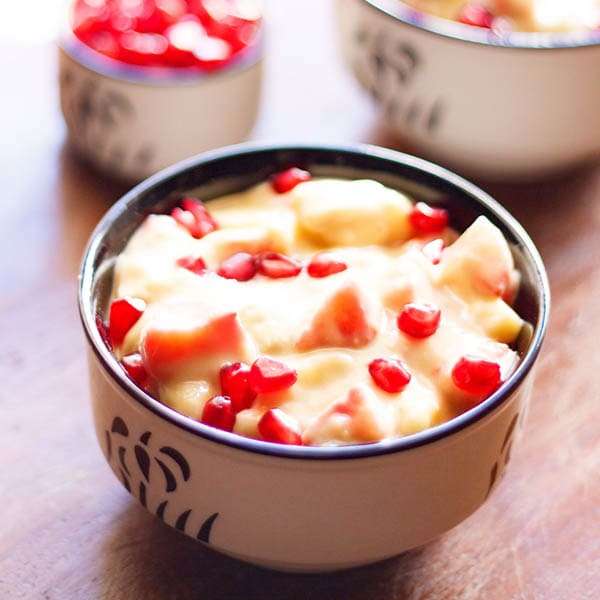
Once cooked, the custard is cooled or refrigerated before adding fresh, chopped seasonal fruits like apples, mangoes, bananas, pears, strawberries, or pomegranate. The combination results in a smooth, creamy custard complementing the varied textures and flavors of the fruits. Variations include using jaggery instead of sugar, substituting custard powder with cornstarch or arrowroot for thickening, or making it suitable for fasting.
This dessert is versatile and can be served chilled as a light, sweet dish after meals or as a snack. It also stores well refrigerated for later consumption.
Ingredients
- 2.5 cups milk whole
- 5 tablespoons sugar
- 3 tablespoons custard powder
- 3 tablespoons milk warm or at room temperature, whole
- 1.5 to 2 cups mixed fruits apples, mangoes, sapota, banana, pears, strawberries, pomegranate, chopped
Instructions
Making custard sauce
- Take milk in a thick bottomed pan or saucepan and keep it on the stove top. Bring the milk to a gentle heat or simmer.
- Whilst the milk is getting heated, in a small bowl, take 3 tablespoon warm milk from the saucepan. Add 3 tbsp custard powder.
- You can opt to take the 3 tablespoons of warm milk from the milk which is getting heated up in the pan or warm 3 tablespoons milk separately in a microwave oven or on the stove top.
- With a whisk stir very well to make a smooth slurry or paste without any lumps.
- When the milk has come to a gentle heat, add the sugar. Stir very well so that the sugar dissolves.
- Keep the heat on a low and then add the custard paste at a time in small portions.
- As soon as you add one portion of the custard slurry or paste, stir quickly so that lumps are not formed. Finish off all the custard paste this way.
- Keep on stirring often while the custard is cooking, so that lumps are not formed. Cook for about 5 to 6 minutes on a low heat.
- The mixture will thicken slowly. For a thicker custard, cook for a few more minutes. Allow the custard to cool at room temperature. Also keep in mind, that as the custard cools, it will thicken more. You can also keep the custard in fridge to chill it before adding the fruits.
Making fruit custard
- Chop the fruits. Use seasonal fruits. Avoid citrus fruits and melons. The fruits I used - apples, papaya, banana, strawberries and pomegranate.
- Once the custard has cooled, add the mixed fruits. Combine to mix.
- Serve fruit custard garnished with some more fruits and pomegranate arils or add some chopped nuts or dry fruits.
Notes
- You may substitute sugar with 5 to 6 tablespoons of jaggery as an alternative sweetener.
- This fruit custard recipe can be scaled up by doubling or tripling the quantities.
- For Navratri fasting, arrowroot flour can replace corn starch for thickening the custard.
- Use seasonal fruits for best flavor and avoid citrus fruits, pineapple, and melons which do not pair well in this custard.
- Stir custard frequently during cooking to prevent lumps and avoid scorching at the pan's bottom.
- If custard powder is unavailable, cornstarch, arrowroot, or tapioca starch can be used with vanilla extract or essence for flavor.
- Warm milk gently, especially when using almond milk, to maintain a smooth texture without over-heating.
Nutrition Information
Show DetailsNutrition Facts
Serving: 3medium dessert bowls
Amount Per Serving
Calories 341 kcal
% Daily Value*
| Calories | 341kcal | 17% |
| Carbohydrates | 60g | 20% |
| Protein | 8g | 16% |
| Fat | 8g | 12% |
| Saturated Fat | 4g | 20% |
| Polyunsaturated Fat | 1g | 6% |
| Monounsaturated Fat | 2g | 10% |
| Cholesterol | 60mg | 20% |
| Sodium | 142mg | 6% |
| Potassium | 479mg | 10% |
| Fiber | 2g | 8% |
| Sugar | 44g | 88% |
| Vitamin A | 744IU | 15% |
| Vitamin B1 (Thiamine) | 1mg | |
| Vitamin B2 (Riboflavin) | 1mg | |
| Vitamin B3 (Niacin) | 1mg | |
| Vitamin B6 | 1mg | |
| Vitamin B12 | 1µg | 42% |
| Vitamin C | 3mg | 3% |
| Vitamin D | 3µg | 15% |
| Vitamin E | 1mg | |
| Vitamin K | 6µg | |
| Calcium | 289mg | 29% |
| Vitamin B9 (Folate) | 18µg | |
| Iron | 1mg | 6% |
| Magnesium | 35mg | 9% |
| Phosphorus | 247mg | |
| Zinc | 1mg |
* Percent Daily Values are based on a 2,000 calorie diet.
User Reviews
Overall Rating
4.8
You'll Also Love