Grain-Free Cut Out Sugar Cookies (1 Bowl!)
User Reviews
5
-
Prep Time
1 hr
-
Cook Time
30 mins
-
Total Time
1 hr 30 mins
-
Servings
48 (Cookies)
-
Calories
75 kcal
-
Course
Dessert
-
Cuisine
gluten-free
Grain-Free Cut Out Sugar Cookies (1 Bowl!)
Description
The Grain-Free Cut Out Sugar Cookies recipe combines dairy-free butter and a room-temperature egg with cane sugar, vanilla extract, baking powder, and sea salt. Almond flour, potato starch, and arrowroot starch provide a gluten-free base that achieves a dough texture firm enough for rolling and cutting. Careful mixing ensures the dough is neither crumbly nor too soft. The dough can be chilled ahead to improve handling and shape retention during baking.
The baking results in a cookie with a soft crumb suitable for decoration. An optional frosting uses dairy-free butter, powdered sugar, and almond milk, which can be tinted with natural dyes for festive finishes. Alternative sweeteners and egg substitutes are suggested with warnings about their untested nature in this formula, indicating the need for caution if deviating from the original ingredients.
This recipe also notes the importance of using softened butter and room-temperature eggs to obtain the proper dough consistency. The cookies can be stored or made ahead by refrigerating the dough for a few days, offering convenience for meal planning or special occasions.
Ingredients
COOKIES
- 1/2 cup dairy-free butter 1/2 cup = 1 stick or 113 g // we prefer Earth Balance or Miyoko's // sub dairy butter if not dairy-free, softened
- 1 small egg see notes for vegan option, chicken, room temperature
- 2/3 cup cane sugar organic
- 1 tsp vanilla extract pure
- 3/4 tsp baking powder
- 1/4 tsp salt sea salt
- 2 ⅓ cups almond flour (not almond meal — the texture and flavor is different), plus more for rolling
- 3/4 cup potato starch (not potato flour)
- 3/4 cup arrowroot starch plus more for rolling
FROSTING optional
- 1/2 cup dairy-free butter 1/2 cup = 1 stick or 113 g // we prefer Earth Balance or Miyoko's // sub dairy butter if not dairy-free, softened
- 1/4 tsp vanilla extract
- 1 ½ - 2 cups powdered sugar organic to ensure vegan-friendly, sifted organic
- 1-2 Tbsp almond milk unsweetened
- natural food dyes (like Watkins or ColorKitchen or my DIY version // optional)
Instructions
- Using softened butter and a room-temperature egg is important to provide the right texture for the dough. To soften butter, set out at room temperature for about 1 hour. Resist the temptation to microwave, which will melt the butter and make it too runny. For the egg (uncracked), place in bowl and top with warm water. Let rest 10 minutes.
- Add softened butter to a large mixing bowl and beat with a mixer on high for 30 seconds. Then add cane sugar, vanilla extract, and room temperature egg and beat on high for 1 minute, scraping down sides as needed.
- Next add baking powder and sea salt and mix again to combine.
- Add almond flour, potato starch, and arrowroot starch and carefully beat on low to combine, switching to a wooden spoon as needed if it becomes difficult to mix. You’re looking for a dough that’s neither crumbly nor too soft, but easy to form in your hand without sticking. If it's too tacky at this point (which we found), add a bit more almond flour, arrowroot, and potato starch a little (~1 Tbsp) at a time and stir until a soft but moldable dough is formed (see photo).
- Cover and freeze for 30 minutes or refrigerate overnight. The dough is easier to roll when chilled.
- In the meantime, preheat oven to 350 degrees F (176 C) and line 1-2 large baking sheets with parchment paper (the recipe as written yields 48 cookies, and we recommend baking ~12 cookies on a tray at a time).
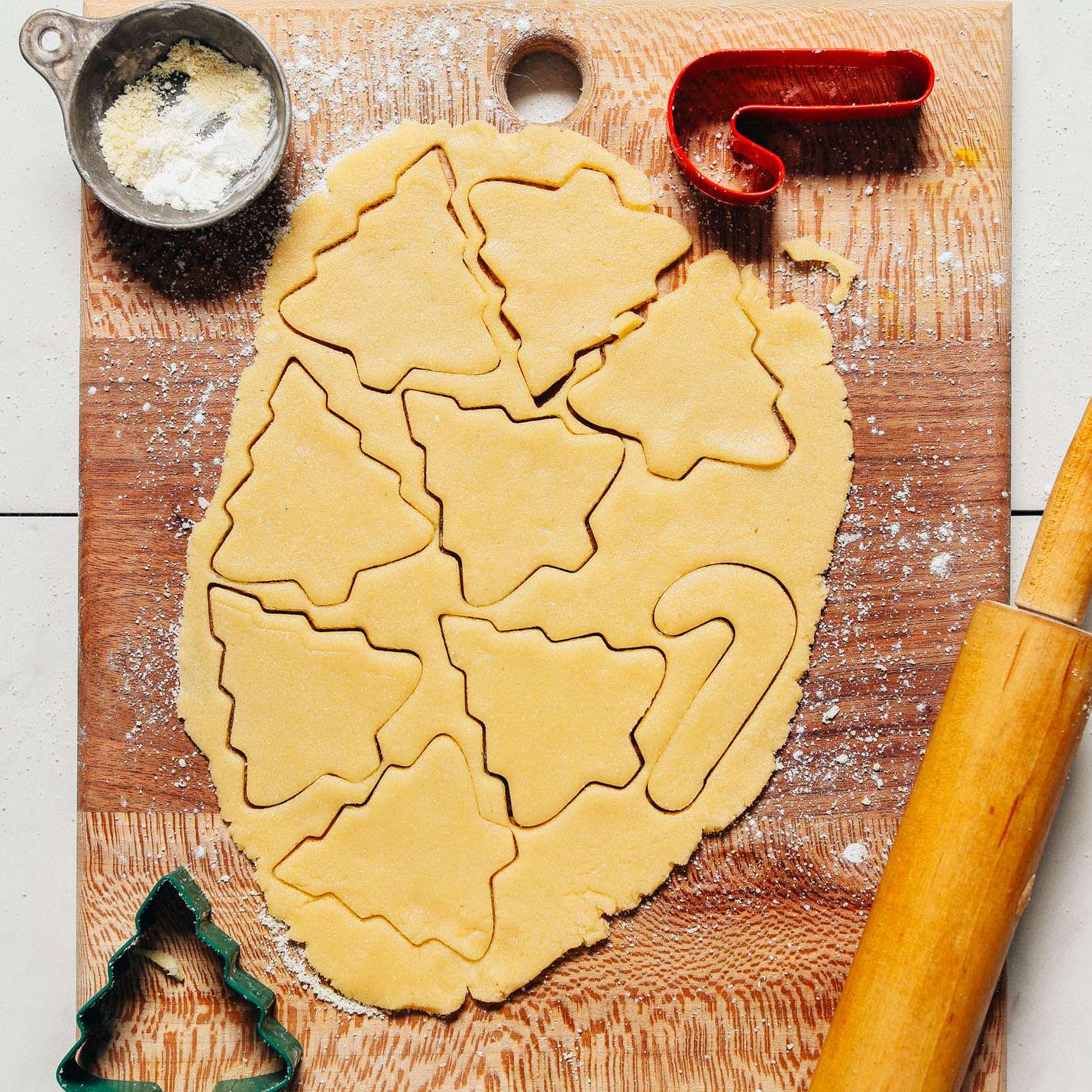
- Once dough is chilled, dust a cutting board or clean surface with arrowroot starch and almond flour (we found the combination to work well to prevent sticking). Then roll into a circle or rectangle about 1/4-inch thick using a rolling pin (add more arrowroot and almond flour as needed to prevent sticking). We found 1/4-inch thick dough to yield fluffy cookies that weren’t too difficult to handle and baked evenly.
- Use cookie cutters of choice to stamp cookies, then use a thin spatula (dusted with arrowroot) to carefully transfer them onto the baking sheet. (Alternatively, you can just scoop out 1-1 ½ Tbsp amounts of dough — we like this scoop — roll into balls, and press down slightly to form a disc. Bake as instructed.)
- Bake cookies for 8.5 - 10 minutes. They don’t need to be golden brown at all to be baked, and they’re actually more soft and fluffy when pulled out just before browning. NOTE: We had the best success baking cookies 1 tray at a time versus 2 (or more).
- Remove from oven and let cool for 5-10 minutes on tray, then transfer to a serving platter or cooling rack, being careful not to stack them until completely cooled.
- Optional: To make frosting, add softened dairy-free butter to a mixing bowl and whisk or beat until soft and fluffy — about 1 minute. Then add the vanilla and sifted powdered sugar in 1/2-cup (56 g) increments and mix. Continue adding powdered sugar until you have spreadable frosting (we used about 2 cups powdered sugar // amount as original recipe is written // adjust if altering batch size). For thinner frosting, add dairy-free milk 1 tsp at a time to thin. If it becomes too thin, add more powdered sugar. If it becomes too thick, add more almond milk. Add natural food coloring or powdered dye of choice at this time (or make our matcha variation!). Once completely cooled, frost cookies or leave plain. We decorated with some naturally-dyed sugar sprinkles like these.
- Storage: Once cooled, store leftover cookies covered at room temperature or in the refrigerator for 3-4 days or in the freezer up to 1 month.
Notes
- Use softened dairy-free butter and a room-temperature egg for optimal dough texture.
- Substitutions like coconut oil are not recommended due to untested results; stick with recommended butter types.
- Sugar can be partially replaced with stevia extract to reduce sweetness, but dough texture may require adding more starches or flours.
- Egg replacers or aquafaba may substitute the egg but may affect the cookie structure and are untested.
- Dough can be made 2-3 days in advance and refrigerated; allow it to soften at room temperature before baking.
- Unbleached all-purpose flour can replace the gluten-free flours if gluten is not a concern, though results may vary.
- Nutrition estimates do not include the optional frosting.
Nutrition Information
Show DetailsNutrition Facts
Serving: 48(Cookies)
Amount Per Serving
Calories 75 kcal
% Daily Value*
| Serving | 1cookies | |
| Calories | 75 | 4% |
| Carbohydrates | 7.7g | 3% |
| Protein | 1.3g | 3% |
| Fat | 4.7g | 7% |
| Saturated Fat | 0.8g | 4% |
| Polyunsaturated Fat | 1.1g | 6% |
| Monounsaturated Fat | 2.62g | 13% |
| Trans Fat | 0g | 0% |
| Cholesterol | 3.85mg | 1% |
| Sodium | 42mg | 2% |
| Potassium | 41mg | 1% |
| Fiber | 0.7g | 3% |
| Sugar | 3g | 6% |
| Vitamin A | 6.5IU | 0% |
| Vitamin C | 0mg | 0% |
| Calcium | 18mg | 2% |
| Iron | 0.21mg | 1% |
* Percent Daily Values are based on a 2,000 calorie diet.
User Reviews
Overall Rating
5
You'll Also Love