Gulab Jamun
User Reviews
4.9
Gulab Jamun
Description
Preparation begins with mixing grated khoya (or alternatively milk powder), all-purpose flour, baking powder, and cardamom powder, combined with ghee and warm milk to form a soft, smooth dough. The dough is rested to allow hydration and easy shaping into small balls without cracks. Careful hand-rolling ensures smooth surfaces, preventing breakage during frying.
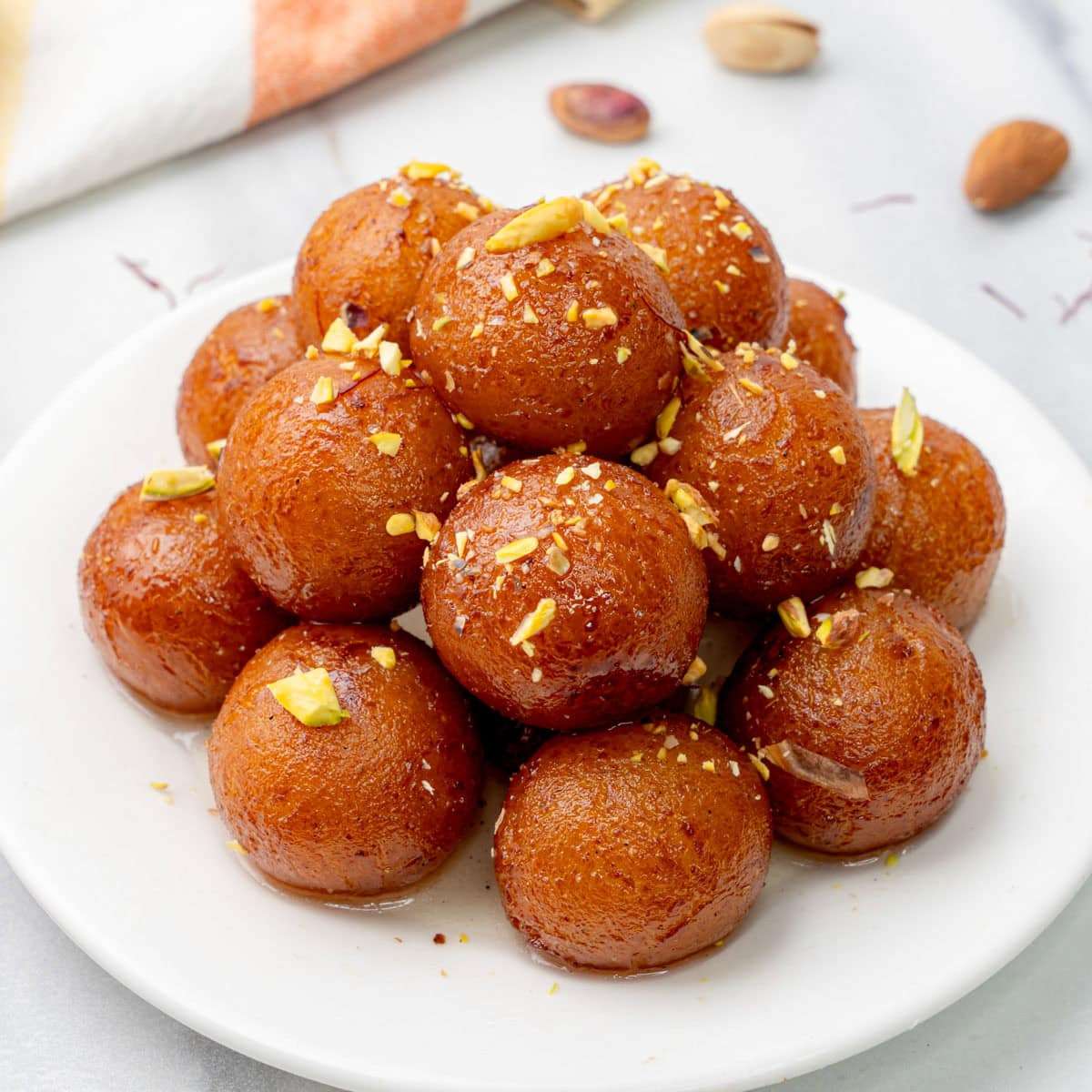
The dough balls are fried slowly in ghee or oil at controlled temperatures to cook through and develop a golden crust. They are then immersed in warm sugar syrup infused with crushed cardamom pods, saffron, rose water, and lime juice, allowing the jamuns to soak and absorb the fragrant syrup, balancing sweetness and floral aroma.
Gulab Jamun can be served warm or at room temperature, often topped with sliced almonds or pistachios. Serving warm with vanilla ice cream is a non-traditional but popular variation. Attention to dough consistency, frying temperature, and syrup heat is key to avoiding common issues such as shrinkage, hardness, or breaking.
Maintaining syrup temperature around 100°F when adding fried jamuns helps prevent shrinking. Dough should not be over-kneaded or pressed, and baking powder amounts should be controlled to preserve softness. These careful steps yield tender, juicy gulab jamuns that hold their shape after syrup soaking.
Ingredients
For Gulab Jamun with Khoya
- 1 cup khoya finely grated or crumbled, about 3oz or 85 grams, or the same amount of Milk Powder
- 3 tablespoon milk Warm, add a little at a time, and use more if needed, whole
- 1/4 cup all-purpose flour 1 oz or 30 grams, maida
- 1/2 teaspoon baking powder
- 1/4 teaspoon cardamom powder aka Elaichi
- 1 tablespoon ghee
For Sugar syrup
- 1 cups granulated sugar white refined
- 1 1/4 cups water
- 2 pods green cardamom crushed or 1/4 teaspoon cardamom powder, aka Elaichi
- 1 pinch saffron aka Kesar
- 1 teaspoon rose water
- 1 teaspoon lime juice
For Frying
- ghee for frying, I prefer ghee, or oil
For Garnish
- 1 tablespoon almonds sliced, to garnish, or pistachios
Instructions
Making the dough with Khoya
- In a large bowl, grate or crumble the khoya. Add all-purpose flour (maida), baking powder, and cardamom powder to it. Mix it well.
- Now add ghee and mix again. Add milk a little at a time until the dough starts to form. You don't want the dough to be sticky. We want enough milk for it to come together. Don't over-mix the dough. You want it to be smooth and soft.
- Cover with a damp cloth and let the dough rest for 30 minutes.
- Gulab Jamun with Milk Powder Variation: I highly recommend measuring the ingredients by weight for this method. Add 1 cup (85 grams) of milk powder, 1/4 cup (30 grams) of all-purpose flour, baking powder, cardamom powder, and ghee. Mix well to make a crumbly mixture. Now, add milk a little at a time until the dough starts to form. I added 6 tablespoons of milk. We want enough milk for it to come together. You want the dough to be a little sticky at this time. Don't over-mix the dough. Cover with a damp cloth and let the dough rest for 30 minutes. After the dough is rested, it will become smooth and soft.
Making sugar syrup for Gulab Jamun
- While the dough is resting, in a bowl, add sugar, water, cardamom pods, and saffron.
- Bring to a boil. Then simmer for 7 minutes. Do not overcook the syrup. The sugar syrup thickens as it cools, so it shouldn’t look too thick.
- Add lemon juice and rose water and stir well. By adding lemon juice, sugar syrup doesn’t form crystals.
- Keep this syrup aside nearby. You need it warm right after frying the gulab jamuns.
Making Gulab Jamun balls
- Grease your palms with some ghee. With your hands, knead the whole dough once.
- Make small balls from the dough about 10 grams each. When rolling the balls, make sure the balls are smooth with no cracks, else they might break when frying. Squeeze the dough between your palms to make it smooth and crack-free. If there are cracks, add a few drops of milk to make it smooth.
- The balls will increase in size after frying & soaking in syrup. Make equal-sized balls, about 19, from this dough.
Frying and soaking the Gulab Jamun
- Heat the ghee/oil well in a fry pan/wok to about 325°F (160°C). Gently add the dough balls to the ghee. Do not overcrowd the pan, and fry in batches.
- Fry on medium-low heat. On high heat, they will get dark from the outside but will not be cooked well from the inside. Stir gently so they are golden brown on all sides.
- Remove them using a slotted spoon. Hold them in the slotted spoon to remove extra oil for 5-10 seconds. Then add them to the syrup while the syrup is warm at around 100°F / 38°C temperature (not boiling hot) so they soak in all the sweetness and become soft. If the syrup is too hot, the balls might break or shrink. If it is cold, then the balls will not soak the syrup well. Soak for at least 30 minutes before enjoying. Soaking for up to 2-3 hours is even better.
- Gulab Jamun's are ready to be enjoyed. Serve warm or at room temperature. Optionally, garnish with slivered pistachios.
Notes
- Serve Gulab Jamun warm or at room temperature with 2-3 jamuns per bowl, topped with syrup and garnished with sliced pistachios or almonds.
- For a rich variation, serve warm gulab jamun with a scoop of vanilla ice cream.
- Avoid excess baking powder to prevent hardening or breaking of jamuns during frying.
- Dough balls should be smooth and soft without cracks; knead again if cracking occurs.
- Maintain oil temperature during frying to ensure even cooking without burning or undercooking inside.
- Ensure dough has appropriate moisture; add milk gradually to avoid dryness which causes hard jamuns.
- Let sugar syrup cool to about 100°F before soaking the jamuns to prevent shrinking.
Nutrition Information
Show DetailsNutrition Facts
Serving: 19Gulab Jamun
Amount Per Serving
Calories 103 kcal
% Daily Value*
| Calories | 103kcal | 5% |
| Carbohydrates | 15g | 5% |
| Protein | 3g | 6% |
| Fat | 4g | 6% |
| Saturated Fat | 2g | 10% |
| Polyunsaturated Fat | 0.1g | 1% |
| Monounsaturated Fat | 1g | 5% |
| Trans Fat | 0.01g | 1% |
| Cholesterol | 5mg | 2% |
| Sodium | 36mg | 2% |
| Potassium | 19mg | 0% |
| Fiber | 0.1g | 0% |
| Sugar | 11g | 22% |
| Vitamin A | 61IU | 1% |
| Vitamin C | 0.3mg | 0% |
| Calcium | 94mg | 9% |
| Iron | 0.1mg | 1% |
* Percent Daily Values are based on a 2,000 calorie diet.
User Reviews
Overall Rating
4.9
You'll Also Love