Japanese Cheesecake
User Reviews
4.7
Japanese Cheesecake
Description
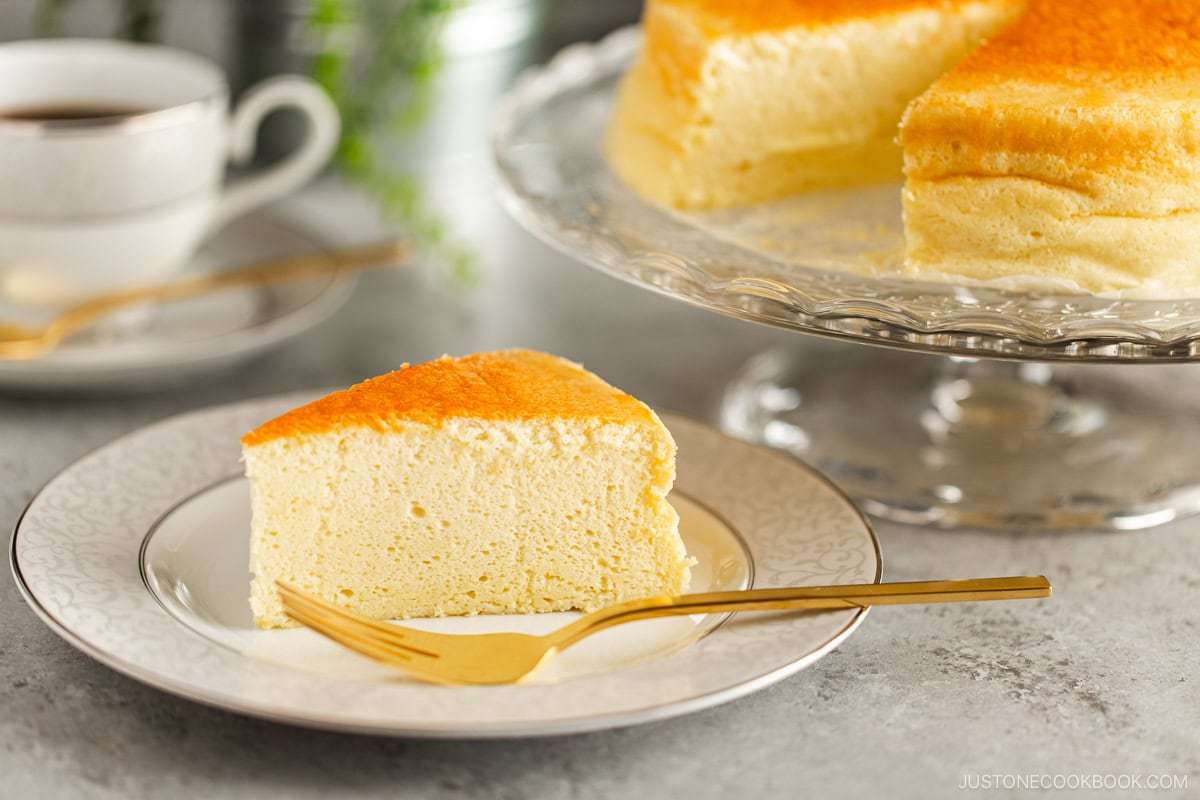
This Japanese Cheesecake blends cream cheese with whipped egg whites, cake flour, lemon zest, and juice to produce a delicate, fluffy cake with a creamy center. The use of cake flour helps maintain a tender crumb while the lemon provides a bright note enhancing the mild sweetness. Butter, heavy cream, and sugar balance richness and texture.
The method involves careful folding of ingredients and baking in a lined pan to support the fragile structure. After baking, a cooling and chilling period of several hours or overnight is required to set the cake, allowing it to develop the soft yet airy consistency distinctive to this style.
The cake is finished with an apricot glaze that adds a light gloss without overpowering the subtle flavors. Suitable as a dessert or tea-time treat, this cheesecake stands apart for its texture that is lighter than traditional Western cheesecakes.
Ingredients
- 1 Tbsp butter for greasing the pan and parchment paper, unsalted
- 6 egg 10.6 oz, 300 g without shell; separated, large, 50 g each, without shell
- 10.6 oz cream cheese (I use full-fat Philadelphia Original Cream Cheese; 1 block is 8 oz)
- 4 Tbsp butter unsalted
- 200 ml heavy cream ¾ cup + 4 tsp; you can substitute whole milk, whipping
- 4½ Tbsp sugar (for the cream cheese mixture)
- ⅔ cup cake flour (please weigh your flour; for weights, click the Metric button; or learn how to measure flour with a measuring cup; click the ingredient link for how to make cake flour at home)
- ½ lemon (large; for the zest and juice)
- 2 Tbsp lemon juice (from the ½ large lemon)
- ½ cup sugar (for the egg whites)
- 2 Tbsp apricot jam (for the glaze)
- 2 tsp water for the glaze, hot
Instructions
Before You Start
- Please note that this recipe requires a cooling time of approximately 1–2 hours and a chilling time of at least 4–6 hours (or overnight) after baking to achieve the perfect creamy yet light texture and balanced flavor. I encourage you to read the blog post for more detailed information that I shared about this recipe.
To Prepare the Cake Pan
- Use a 9-inch (23-cm) cake pan that is 4 inches (10 cm) high. Cut parchment paper to line the bottom and sides of the cake pan. Cut one circle 9 inches (23 cm) in diameter for the bottom and one rectangular strip 4 x 30 inches (10 x 76 cm) for the sides of the cake pan. In addition, cut two strips of paper 2 x 30 inches (5 x 76 cm) each. We will use these as “straps” to lift the baked cake from the pan.
- With 1 Tbsp unsalted butter, grease the cake pan and the parchment paper on one side (for the bottom and the sides so the greased sides will touch the cake batter). You don‘t need to use all the butter.
- Crisscross the two parchment paper straps on the bottom of the cake pan so they form an “X.” Allow the excess paper to hang over the sides. Then, line the bottom and sides with the parchment paper so the greased sides will touch the cake pan. The greased side of the paper circle should face down, and the greased side of the rectangular strip should face toward the pan.
To Preheat the Oven and Prepare a Double Boiler
- Preheat the oven to 350ºF (180ºC). For a convection oven, reduce the temperature by 25ºF (15ºC). Note: You will be baking at 320ºF (160ºC). However, we’ll preheat a bit higher because your oven will lose some heat when you open it to place the cheesecake inside.
- Prepare a double boiler: Set a medium saucepan filled with 2 inches (5 cm) of water over high heat and bring it to a simmer, then cover and reduce the heat to maintain a steady simmer.
To Gather the Ingredients
- Gather all the ingredients. It is very important to measure all your ingredients before starting. Separate 6 large eggs (50 g each w/o shell) into yolks and whites and place the egg whites back in the refrigerator. I highly encourage you to weigh your ingredients using a kitchen scale. For weights, click the Metric button above to convert the measurements to metric. If you don't have a scale, here's how to measure flour with a measuring cup: Fluff the flour with a spoon, sprinkle it into the measuring cup, and level it off. Otherwise, you may scoop more than you need.
To Make the Cake Batter
- In a large bowl, add 10.6 oz cream cheese, 4 Tbsp unsalted butter, 200 ml heavy (whipping) cream, and 4½ Tbsp sugar. Rest the bowl on the saucepan above the simmering water. Tip: The double boiler will warm up and soften the cream cheese and butter, so you don't need to bring these ingredients to room temperature ahead of time.
- Mash the cream cheese and butter with a silicone spatula. Once they are softened, use a hand whisk to blend everything together. Remove the bowl from the heat.
- Whisk the egg yolks, one at a time, into the warm cream cheese mixture. Make sure each yolk is blended well with the cream cheese mixture before adding the next one.
- Using a fine-mesh strainer, sift ⅔ cup cake flour into the batter. Whisk and blend together.
- Then, pass the batter through the same fine-mesh strainer into a clean large bowl. This creates a silky texture for the batter.
- Add the zest of ½ lemon into the batter. Make sure you only zest the flavorful yellow part and not the bitter white pith. Into a separate small bowl, squeeze the juice from the lemon. Measure 2 Tbsp lemon juice and add it to the batter. Whisk well to blend and set aside.
To Set Up the Bain-Marie (Water Bath)
- Put a large baking sheet inside the preheating oven and pour in hot water until it is halfway up the sides or ½ inch deep. Close the oven door.
To Beat and Incorporate the Egg Whites
- Add the cold egg whites into the dry, clean mixing bowl of a stand mixer. Make sure there is no oil or water in the bowl. If you have space in your refrigerator, I highly recommend keeping the mixing bowl cold until you’re ready to use it. Start whisking on medium speed (Speed 4) until the egg whites become opaque, foamy, and bubbly, about 2 minutes. Then, slowly add ½ cup sugar, one-third of it at a time, while the mixer runs.
- Once you’ve added all the sugar, increase the mixer speed to high (Speed 8–9) and beat the egg whites until you have firm peaks. When you lift the whisk and turn it over, the egg whites should cling to the whisk and hold their shape fairly well, but the tip of the peak should fold back on itself.
- Using a hand whisk, mix one-third of the egg whites into the cream cheese mixture until incorporated. Then, gently fold another one-third into the mixture.
- Lastly, pour the mixture back into the mixer bowl with the last one-third of the egg whites still in it. Fold very gently until just combined.
- Pour the batter into the cake pan all at once, avoiding air pockets while pouring. Tap the cake pan a few times on the kitchen counter to release any air pockets in the batter.
To Bake the Cheesecake
- Open the oven and place the cake pan onto the baking sheet with the bain-marie. Reduce the oven temperature to 320ºF (160ºC)—25ºF (15ºC) lower for a convection oven—and bake for 70–75 minutes. Then, reduce the oven temperature to 300ºF (150ºC) and bake for another 10 minutes, or until the top is golden brown. To test for doneness, open the oven door slightly and insert a skewer into the cake. If the skewer comes out without wet batter, it‘s done. Leave the cake inside the oven.
To Cool
- Turn off the oven and leave the oven door slightly ajar for 15–20 minutes with the cake inside so it cools gradually. If you immediately remove the cake pan to the kitchen counter, the sudden change in temperature could cause the soufflé cheesecake to collapse. While cooling in the oven, you want the cake to slowly shrink down to half its height, from roughly 4 inches to 2 inches high. After 15–20 minutes, remove the cake pan from the oven.
- Gently lift out the cheesecake from the pan using the two parchment paper straps (with help from another set of hands). Place the cake on a plate.
- Remove the parchment paper from around the sides (but leave the bottom paper). Combine 2 Tbsp apricot jam and 2 tsp hot water in a small bowl. Brush the apricot glaze over the top of the cheesecake. Let cool to room temperature.
To Serve
- Allow the cheesecake to cool completely in the refrigerator for at least 4–6 hours or overnight. Chilled cheesecake has a creamy yet light texture, with a perfectly balanced flavor.If you prefer a softer texture, take the cheesecake out of the fridge about 10–15 minutes before serving. This allows the flavors to mellow and the texture to become even fluffier.
To Slice
- Use a clean, sharp knife dipped in warm water and wipe clean between slices to ensure neat and tidy cuts, as soufflé cheesecake can be quite delicate.
To Store
- You can store the cake in the refrigerator for up to 3–4 days or in the freezer for 3–4 weeks. Thaw the cake overnight in the refrigerator. The cold cheesecake is dense, so leave it on the counter until just chilled before serving.
Notes
- Use cake flour to achieve the correct delicate texture; if unavailable, substitute all-purpose flour with cornstarch as explained in the notes.
- Ensure beaters and bowls are clean and dry before whipping egg whites to maximize volume.
- Avoid plastic bowls for egg whites as they may retain residue that inhibits whipping.
- Allow at least 4-6 hours of chilling after baking for the best texture and flavor balance.
Nutrition Information
Show DetailsNutrition Facts
Serving: 1cake
Amount Per Serving
Calories 3560 kcal
% Daily Value*
| Serving | 9inch cake | |
| Calories | 3560kcal | 178% |
| Carbohydrates | 266g | 89% |
| Protein | 70g | 140% |
| Fat | 252g | 388% |
| Saturated Fat | 142g | 710% |
| Trans Fat | 2g | 100% |
| Cholesterol | 1838mg | 613% |
| Sodium | 1488mg | 62% |
| Potassium | 1137mg | 24% |
| Fiber | 3g | 12% |
| Sugar | 189g | 378% |
| Vitamin A | 10053IU | 201% |
| Vitamin C | 21mg | 23% |
| Calcium | 631mg | 63% |
| Iron | 8mg | 44% |
* Percent Daily Values are based on a 2,000 calorie diet.
User Reviews
Overall Rating
4.7
You'll Also Love