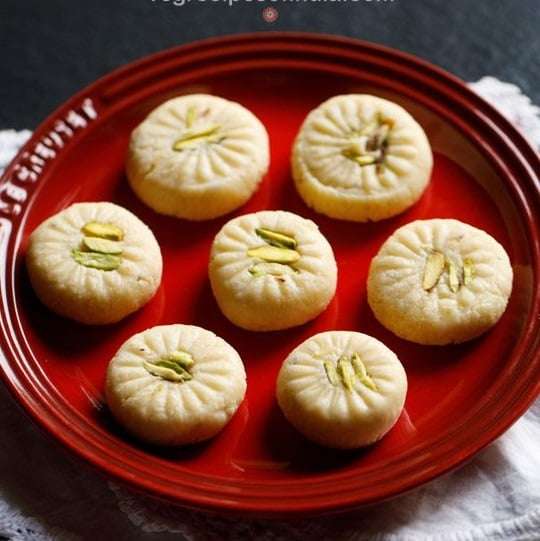
Milk Peda Recipe (Doodh Peda)
User Reviews
4.9
Milk Peda Recipe (Doodh Peda)
Description
This Milk Peda recipe uses freshly grated khoya, which is slowly cooked over low heat along with sugar and cardamom powder while stirring continuously. The addition of milk helps achieve a smooth, melt-in-the-mouth consistency as the mixture thickens without browning. Constant stirring prevents burning and promotes even thickening.
Once the mixture thickens and begins to leave the sides of the pan, it is spread on a tray to cool slightly, then shaped into small round pedas. The nut garnish adds a pleasant crunch contrast to the soft peda.
The pedas have a delicate balance of sweetness and the warm fragrance of cardamom, which enhances the milk’s natural flavors. They are typically stored and served as a festive sweet or dessert.
Care must be taken not to undercook, which results in sticky pedas that won’t hold shape, or overcook, which makes them chewy. Using a heavy-bottomed pan helps regulate heat and prevent burning.
Ingredients
- 200 to 205 grams khoya - grated or 1 cup tightly packed grated khoya (mawa or evaporated and dried milk solids)
- ½ cup sugar - 125 grams sugar or add as required
- ½ teaspoon cardamom powder
- 2 to 3 tablespoons milk
- 3 to 4 pistachio or almonds- slivered or thinly sliced
Instructions
Making peda mixture
- First grate the khoya. Take the grated khoya in a heavy kadai or skillet. You will need 1 cup tightly packed grated khoya. You can use homemade or store brought khoya. I have used instant khoya.
- Add sugar and cardamom powder.
- Keep the pan on a stove top on a low heat.
- Then mix the khoya with the sugar very well.
- Next add milk and again stir to combine. Keep stirring often.
- You will see the sugar melting and the mixture getting a liquid consistency.
- Continuously keep on stirring and simmer the peda mixture with a spatula. You have to stir non-stop so that the mixture does not get browned from the bottom.
- Stir often and the mixture will start bubbling.
- Continue to stir and cook till the mixture thickens and leaves the sides of the pan.
- Then immediately pour the entire peda mixture in a steel plate or a tray. When you pour the mixture it will still be in a molten state but thickened. Do not over cook as then the pedas will become chewy.
- Let it become warm at room temperature.
Making doodh peda
- Now take small portions from the lukewarm peda mixture and roll them into small to medium balls.
- Place a few slivered pistachios or almonds on top of each peda ball.
- With a peda maker, press each ball to give a distinct design on top of it. If you do not have a peda maker, then just roll the mixture in balls and then flatten them. Press a few almonds or pistachios on top.
- Make a design on all doodh peda with the peda maker. In case the doodh peda falls flat and does hold shape, then they are slightly undercooked. Gather all the mixture together and heat again in the pan for 2 to 3 minutes or till the mixture leaves sides of the pan.
- Now you can store the milk peda for a few hours at room temperature and then serve later. Leftovers can be refrigerated. This doodh peda recipe yields 12 medium sized peda.
Notes
- Check the expiry date when using packaged or store-bought khoya; discard if sour or rancid.
- Maintain low heat and stir continuously while cooking to avoid burning or browning the mixture.
- Use a heavy, thick-bottomed pan to ensure even cooking and prevent scorching.
- Do not overcook or undercook; overcooked mixture yields chewy pedas, while undercooked will be sticky and unshapable.
- This recipe can be doubled or halved as needed.
- Approximate nutrition information is based on one peda.
Nutrition Information
Show DetailsNutrition Facts
Serving: 12peda
Amount Per Serving
Calories 100 kcal
% Daily Value*
| Calories | 100kcal | 5% |
| Carbohydrates | 12g | 4% |
| Protein | 3g | 6% |
| Fat | 4g | 6% |
| Saturated Fat | 3g | 15% |
| Polyunsaturated Fat | 1g | 6% |
| Monounsaturated Fat | 1g | 5% |
| Trans Fat | 1g | 50% |
| Cholesterol | 4mg | 1% |
| Sodium | 46mg | 2% |
| Potassium | 9mg | 0% |
| Fiber | 1g | 4% |
| Sugar | 8g | 16% |
| Vitamin A | 81IU | 2% |
| Vitamin B1 (Thiamine) | 1mg | |
| Vitamin B2 (Riboflavin) | 1mg | |
| Vitamin B3 (Niacin) | 1mg | |
| Vitamin B6 | 1mg | |
| Vitamin B12 | 1µg | 42% |
| Vitamin C | 1mg | 1% |
| Vitamin D | 1µg | 5% |
| Vitamin E | 1mg | |
| Vitamin K | 1µg | |
| Calcium | 118mg | 12% |
| Vitamin B9 (Folate) | 1µg | |
| Iron | 1mg | 6% |
| Magnesium | 1mg | 0% |
| Phosphorus | 4mg | |
| Zinc | 1mg |
* Percent Daily Values are based on a 2,000 calorie diet.
User Reviews
Overall Rating
4.9
You'll Also Love