Moong Dal Halwa
User Reviews
4.8
Moong Dal Halwa
Description
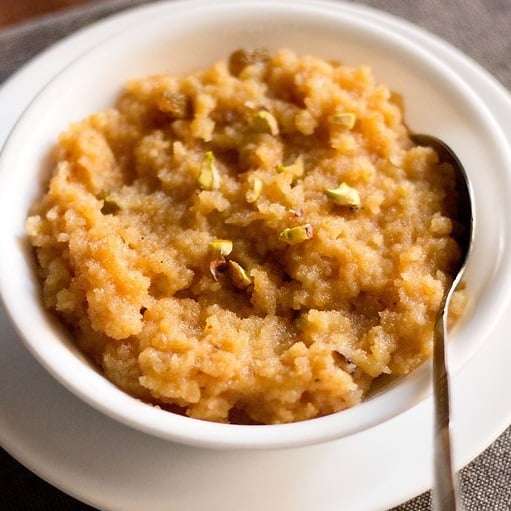
This Moong Dal Halwa begins by soaking moong dal for several hours to soften it for grinding into a fine paste. The ground lentil paste is then cooked slowly in ghee, where it initially forms lumps but breaks down as the fat separates. Constant stirring is necessary to ensure even cooking and prevent sticking.
Separately, a mixture of milk, water, and sugar is heated until the sugar dissolves. This sweetened liquid is gradually added to the cooking dal paste, continuing to stir until the mixture thickens into a smooth, moist halwa. The addition of cardamom powder gives the dessert a fragrant aroma.
The halwa is garnished with chopped pistachios or almonds and golden raisins, which provide textural contrast. It is usually served warm as a festive or special occasion sweet.
Soaking the lentils sufficiently facilitates smooth grinding and prevents watery batter. Sugar quantity can be adjusted to taste, with a base of 1 cup providing moderate sweetness. The recipe can be scaled up or down as needed.
Ingredients
Main ingredients
- 1 cup moong dal (spilt husked yellow mung lentils)
- 9 to 10 tablespoon ghee (clarified butter)
- 4 green cardamom husked and powdered in a mortar-pestle or ¼ to ⅓ teaspoon cardamom powder
- 10 to 12 pistachio unsalted), sliced or chopped or 10 to 12 blanched almonds - sliced
- 1 tablespoon golden raisins
To be mixed together
- 1 cup milk whole
- 2 cups water
- 1 or 1.25 cups sugar or raw sugar * check notes
Instructions
Making moong dal paste
- Soak the moong dal or mung lentils, in enough water overnight or for 4 to 5 hours.
- Drain and then grind the moong dal to a smooth paste with ¼ or ⅓ cup water to a smooth and fine consistency.
Making moong dal halwa
- Melt ghee in a nonstick kadai or frying pan or a well-seasoned wok or frying pan. Add the ground moong dal. Stir and mix well.
- Keep on stirring the halwa on a medium-low to medium heat. The halwa has the raw aroma of the moong lentils and it should go away completely before you start with the next step. So till then you have to stir and cook the halwa.
- The halwa first is pasty, then starts getting lumpy and then starts breaking down and getting separated with the fat releasing from the sides. Break the lumps while stirring.
- Meanwhile when the halwa is cooking, in another pan or kadai, take milk, water and sugar.
- Keep this pan on the stove top and stir so that the sugar dissolves. On a low or medium flame, heat this milk-water-sugar mixture till it comes to a boil.
- The moong dal mixture should reach a granular consistency before you add the hot milk mixture. You should get a fried aroma from the mung lentils and the color should become golden. The fat also should get separated.
- When the milk mixture comes to a boil, add it to the fried mung lentils.
- The mixture sizzles, so be careful while adding the hot milk and water mixture.
- Stir well. Simmer and cook stirring often.
- The liquids should get absorbed and once again you will see the ghee getting separated.
- Lastly add cardamom powder, chopped pistachios and raisins.
- Serve Moong Dal Halwa hot. You can also garnish with some pistachios and serve.
Notes
- Soak moong dal for several hours to enable smooth grinding without adding excess water.
- Adjust sugar quantity to preference; 1 cup sugar yields moderate sweetness, add more for sweeter halwa.
- Use powdered cardamom for even distribution of aroma throughout the halwa.
- The recipe can be halved or doubled to suit serving needs.
Nutrition Information
Show DetailsNutrition Facts
Serving: 6Serving
Amount Per Serving
Calories 662 kcal
% Daily Value*
| Calories | 662kcal | 33% |
| Carbohydrates | 101g | 34% |
| Protein | 11g | 22% |
| Fat | 25g | 38% |
| Saturated Fat | 15g | 75% |
| Polyunsaturated Fat | 1g | 6% |
| Monounsaturated Fat | 7g | 35% |
| Cholesterol | 62mg | 21% |
| Sodium | 33mg | 1% |
| Potassium | 133mg | 3% |
| Fiber | 4g | 16% |
| Sugar | 79g | 158% |
| Vitamin A | 137IU | 3% |
| Vitamin B1 (Thiamine) | 0.04mg | |
| Vitamin B2 (Riboflavin) | 0.1mg | |
| Vitamin B3 (Niacin) | 0.1mg | |
| Vitamin B6 | 0.1mg | |
| Vitamin B12 | 0.2µg | 8% |
| Vitamin C | 0.4mg | 0% |
| Vitamin D | 0.4µg | 2% |
| Vitamin E | 0.1mg | |
| Vitamin K | 0.4µg | |
| Calcium | 83mg | 8% |
| Vitamin B9 (Folate) | 1µg | |
| Iron | 2mg | 11% |
| Magnesium | 13mg | 3% |
| Phosphorus | 55mg | |
| Zinc | 0.3mg |
* Percent Daily Values are based on a 2,000 calorie diet.
User Reviews
Overall Rating
4.8
You'll Also Love