Payesh Recipe | Nolen Gurer Payesh
User Reviews
5
Payesh Recipe | Nolen Gurer Payesh
Description
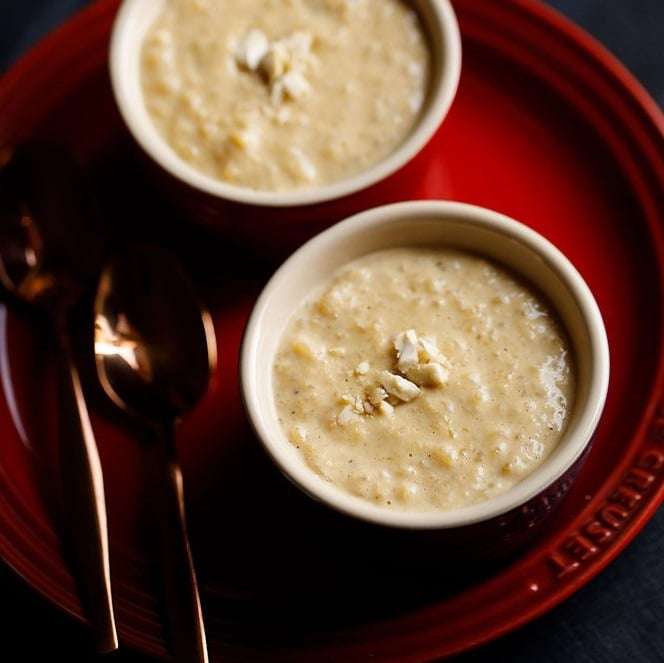
The Payesh Recipe, also known as Nolen Gurer Payesh, centers on soaking basmati or gobind bhog rice and then cooking it in simmered whole milk, which slowly reduces to a more concentrated creaminess. Date palm jaggery is incorporated as the sweetener, offering a nuanced and earthy sweetness that sets this pudding apart from versions using refined sugar. Aromatic Indian bay leaf and ground cardamom warm the flavor profile without overpowering the naturally sweetened milk and rice.
The texture is soft with tender rice grains nestled in thickened milk, punctuated optionally by buttery cashews or golden raisins for crunch and bursts of sweetness. The slow simmer and frequent stirring prevent sticking and encourage the melding of flavors, yielding a decadent yet traditional dessert texture.
Payesh is often served chilled or at room temperature, making it suitable as a festive sweet or comfort food. Its subtle richness pairs well with simple accompaniments or as a finale to a meal. The recipe provides flexibility for scaling and variations in nuts and dried fruits according to preference.
The notes advise using whole milk to prevent splitting when adding jaggery and emphasize frequent stirring at all stages of cooking to avoid burning. Palm sugar or coconut sugar may substitute the jaggery if desired. The recipe allows customization with different nuts or fruits and can be adjusted for portion sizes.
Ingredients
- ¼ cup basmati rice or gobind bhog rice, 50 grams
- 1 litre milk whole
- ½ cup date palm jaggery chopped, or 100 grams, can add more if required
- 1 tej patta - small-dozed, (Indian bay leaf)
- ¼ teaspoon green cardamom powder
- 2 tablespoons cashews or almonds, sliced or chopped - optional
- 1 tablespoon golden raisins - optional
Instructions
Preparation
- Rinse ¼ cup basmati rice or gobind bhog rice a couple of times.
- Soak the rinsed rice grains in water covering them for about 20 minutes.
- Chop date palm jaggery and set aside.
- You will need ½ cup of chopped dates palm jaggery.
Making nolen gurer payesh
- Take milk in a heavy kadai or pan.
- Keep heat to low and begin to heat milk.
- Stir occasionally when the milk is getting heated.
- Let the milk come to a boil. Then continue to simmer the milk for 8 to 10 minutes more after it comes to a boil. Stir often. The milk will start reducing in this period of time.
- After 8 to 10 minutes of simmering, drain all the water from the rice and add to the milk.
- Then add 1 small tej patta and ¼ teaspoon green cardamom powder. Mix very well.
- Simmer on low heat until the rice grains are softened and cooked. Stir often.
- As the rice grains get cooked, the milk will also thicken and reduce more. So stir often so that rice does not stick to the pan.
- By the time the rice grains are cooked well the milk will thicken well.
- Simmer on low heat.
- The rice grains have to be tender, softened and cooked well. So you can taste or mash a few rice grains to see if they have cooked thoroughly.
- Once the rice grains are softened, then turn off the heat.
- Then add 2 tablespoons cashews and 1 tablespoon raisins. You can also add almonds or pistachios instead of cashews. Mix very well.
- Remove the pan from the stovetop and keep on the counter top for 3 to 4 minutes till the heat reduces a bit.
- Then add one portion of the chopped dates palm jaggery. Mix very well until most of the jaggery has dissolved.
- Add the remaining jaggery.
- Mix again very well until all of the jaggery dissolves.
- Serve Nolen Gurer Payesh hot or warm. You can also refrigerate and serve this Rice Payesh chilled. While serving garnish with a few chopped cashews.
Notes
- Use whole milk to avoid splitting when adding date palm jaggery.
- Stir frequently during heating and cooking to prevent milk or payesh from sticking to the pan.
- Substitutes for palm jaggery include palm sugar or coconut sugar.
- Feel free to add various nuts and dried fruits based on preference.
- The recipe quantities can be increased or decreased to serve more or fewer people.
Nutrition Information
Show DetailsNutrition Facts
Serving: 4Serving
Amount Per Serving
Calories 302 kcal
% Daily Value*
| Calories | 302kcal | 15% |
| Carbohydrates | 43g | 14% |
| Protein | 10g | 20% |
| Fat | 11g | 17% |
| Saturated Fat | 5g | 25% |
| Polyunsaturated Fat | 1g | 6% |
| Monounsaturated Fat | 3g | 15% |
| Cholesterol | 31mg | 10% |
| Sodium | 139mg | 6% |
| Potassium | 463mg | 10% |
| Fiber | 1g | 4% |
| Sugar | 28g | 56% |
| Vitamin A | 419IU | 8% |
| Vitamin B1 (Thiamine) | 0.2mg | |
| Vitamin B2 (Riboflavin) | 0.4mg | |
| Vitamin B3 (Niacin) | 1mg | |
| Vitamin B6 | 0.2mg | |
| Vitamin B12 | 1µg | 42% |
| Vitamin C | 0.2mg | 0% |
| Vitamin D | 3µg | 15% |
| Vitamin E | 0.2mg | |
| Vitamin K | 3µg | |
| Calcium | 325mg | 33% |
| Vitamin B9 (Folate) | 2µg | |
| Iron | 1mg | 6% |
| Magnesium | 50mg | 13% |
| Phosphorus | 308mg | |
| Zinc | 1mg |
* Percent Daily Values are based on a 2,000 calorie diet.
User Reviews
Overall Rating
5
You'll Also Love